BEIJING, May 18 (Xinhua) -- In China today, an increasing number of young people are rediscovering the past -- not just by visiting museums and historical sites, but by stepping behind the scenes to restore cultural relics.
Armed with brushes, tweezers and glue, these young cultural relic restorers are quietly embracing the craft as a career, breathing new life into ancient treasures that might otherwise be lost to the sands of time.
Xie Li, a cultural relic restorer at the Sanxingdui Museum in southwest China's Sichuan Province, is part of this growing trend. Born in the 1990s, she has spent 11 years in the field and witnessed firsthand the transformation of the industry over the past decade.
"When I was a student, only one or two out of a class of 70 or 80 would go into heritage work," Xie recalled. "Now, in a class of about a hundred, dozens are choosing this path."
At the Sanxingdui Museum, she noted, the average age of the restoration team is just 35, with the youngest member born in 1998.
She attributes this shift in part to the rise of archaeology-themed documentaries and other forms of cultural media, which have sparked a wave of enthusiasm and drawn more young people into heritage preservation.
For Xie, pursuing a career she loves brings a deep sense of fulfillment. "Every time I finish restoring a piece -- watching it go from broken to whole -- I feel a wave of satisfaction, as if I've brought it back to life," she said.
Recently, Xie competed in the Sichuan provincial qualifiers of the 2025 National Cultural Heritage Vocational Skills Competition, earning second prize in the metal relic restoration category for her work on a replica bronze mask.
The competition brought together participants born from the 1960s to the 2000s, with some of the winners being young restorers in their twenties and thirties.
"It seems like there are more young contestants than before." At the event, three expert advisors all noted the same trend.
In addition to young people's growing interest in traditional culture, Zhu Xiaonan, an expert from the National Cultural Heritage Administration (NCHA), highlighted changes in the country's system for training talent.
"Previously, cultural relic restoration was mostly passed down through a master-apprentice system. But now, many universities have started offering related programs," Zhu said.
In recent years, China has placed growing emphasis on preserving its cultural heritage, creating a pressing need for skilled professionals to improve the quality of relic restoration.

In 2016, China's State Council issued a guideline on strengthening cultural relics work, calling for accelerated training of urgently needed talent in areas such as cultural heritage conservation and restoration.
The following year, China introduced its first undergraduate program in cultural relic conservation and restoration. Since then, over 60 universities and colleges, as well as more than 30 vocational colleges, have followed suit with similar programs.
Yet despite this surge in training efforts, a significant shortage of qualified professionals remains.
As a country rich in cultural heritage, China is home to more than 760,000 immovable cultural relics and over 100 million artifacts housed in museum collections, with a vast number of relics still awaiting restoration.
At the same time, academic education in cultural heritage conservation and restoration remains insufficient, said Wang Yingsheng, dean of the School of Conservation at the Central Academy of Fine Arts.
"Restorers without formal academic training in aesthetics often lack a deep understanding of materials and art," Wang noted.
To address this gap, provinces with major cultural heritage sites, such as Shandong, Shanxi and Shaanxi, launched government-funded undergraduate programs last year for students specializing in cultural relics, offering guaranteed jobs upon graduation.
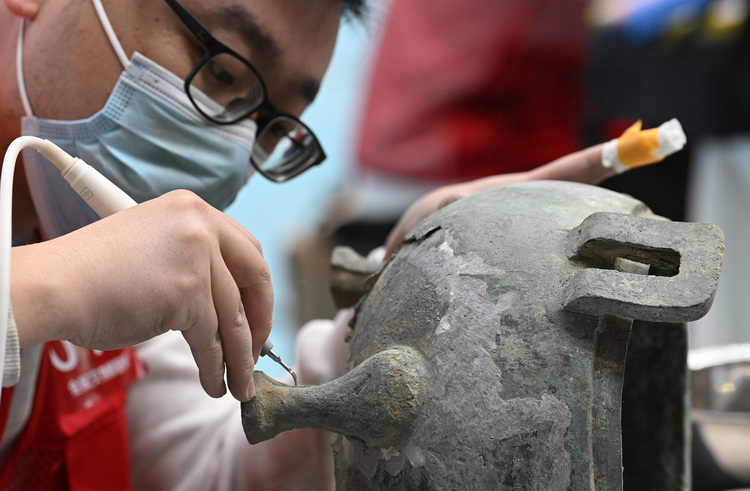
In Shandong, for instance, the program plans to enroll around 300 students over five years, waiving tuition and accommodation fees and providing a living allowance.
Job opportunities are also increasing. According to the NCHA, staffing in cultural heritage protection and archaeological institutions at all levels is steadily expanding, along with a significant rise in archaeological fieldwork allowances.
As a result, more and more students are proactively choosing to major in cultural heritage and archaeology.
Shen Ruiwen, dean of the School of Archaeology and Museology at Peking University, said that more than 10 years ago, the school admitted just over 20 students annually. Today, that number has jumped to 40 to 50 each year, with high-scoring applicants eagerly competing for admission.
Once an obscure profession, the art of cultural relic restoration is gradually coming into the spotlight.
Fueled by a deep passion for their craft, a growing number of young, tech-savvy restorers are turning to social media to share the joys of their daily work.
Among them is Yu Mingrui, a specialist in restoring ancient calligraphy and paintings. Since he began posting short videos of his work online, some of his posts have gone viral, attracting an ever-growing number of followers.
To his surprise, the videos have not only sparked interest but also changed lives. One younger student, torn between practical considerations and his passion for relic restoration, decided to apply for a restoration program after watching Yu's content. This story stuck with Yu and deepened his sense of purpose.
"We're passing this craft down, generation after generation, to keep culture alive," he said. "Even if no one remembers our names, the country still needs people to carry the torch. And there must always be young people ready to step up."
| Museums in China register 1.49 billion visits in 2024 2025-05-18 | |
| 美国企业掀起“抢运潮”的背后尽显焦虑 2025-05-18 | |
| 玉渊谭天丨中美谈判后中巴合作依旧爆单 巴西总统卢拉回应外媒质疑 2025-05-17 | |
| 美学者:美国应尽早认清自身积弊 与中国合作谋求共赢 2025-05-17 |
