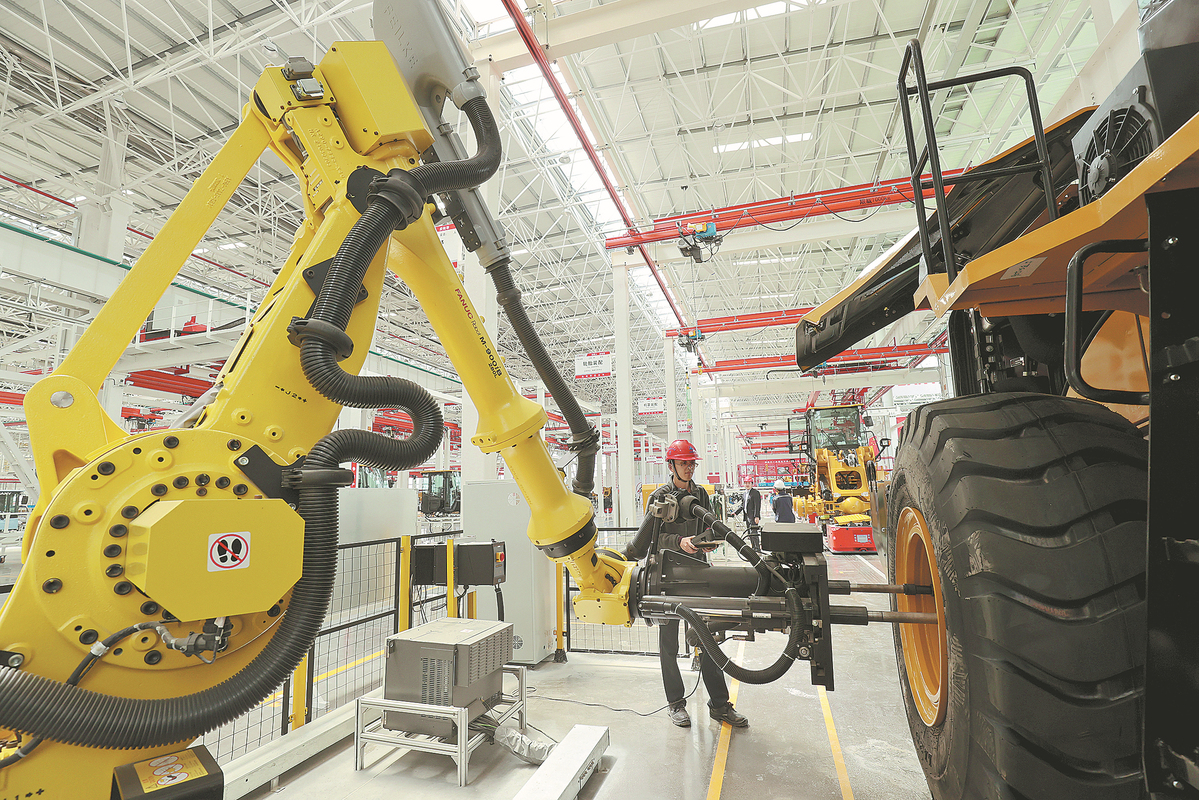
An employee operates a robotic arm at an AI manufacturing plant in Huzhou, Zhejiang province. XIE SHANGGUO/FOR CHINA DAILY
A sustained focus on supporting innovation in strategic emerging sectors, future industries and traditional industries will be high on the agenda as China advances its economic structural reforms, which are aimed at fostering new quality productive forces and driving a shift from old growth drivers to new ones, economists and entrepreneurs said.
Economists said the new quality productive forces will serve as a key driver for boosting the country's economic growth in the coming years, which will help offset the real estate downturn, accelerate the building of a modern industrial system and promote high-quality development in the long run.
Huang Hanquan, head of the Chinese Academy of Macroeconomic Research, said that fostering new quality productive forces is of vital importance in promoting high-quality economic growth, boosting total factor productivity and realizing Chinese modernization.
"Various regions and departments across China have embraced this approach to drive economic progress, which will significantly accelerate technological innovation, enhance industrial application and facilitate the shift of growth drivers from old to new ones," Huang said.
A new report says that despite geopolitical headwinds that are having an impact on China's economic growth trajectory and momentum, the nation is achieving success by boosting investment in science and technology, as well as by refocusing its efforts to enhance capabilities in emerging industries including artificial intelligence, autonomous vehicles and electric vehicles, and this is key to reinvigorating China's growth engine.
According to the Milken Institute's Best-Performing Cities China Index, cities that were home to a significant number of tech hubs displayed a high level of economic resilience. According to the report, Chinese cities that have strategically invested in emerging technologies will continue to thrive, even as the broader economy faces challenges at home and abroad.
Highlighting that sci-tech innovation is a key element in the development of new quality productive forces, Huang from the Chinese Academy of Macroeconomic Research called for more efforts to achieve breakthroughs in core technologies by investing more in fundamental research and tackling choke points, and by stepping up reforms in the science and technology, education and talent systems.
More efforts should also be made to advance reforms in the market-based allocation of production factors, allowing factors such as land, labor, capital and technology to flow freely and efficiently to fields of new quality productive forces, he said.
Looking ahead, Huang said the country should foster new pillar industries, including next-generation information technology, new energy vehicles, new energy and new materials, to offset the impact of the decline in real estate on China's economy and create new growth drivers.
Huang's remarks came after a resolution adopted in July at the third plenary session of the 20th Central Committee of the Communist Party of China placed great emphasis on improving the institutions and mechanisms for fostering new quality productive forces in line with local conditions.
Justin Yifu Lin, dean of Peking University's Institute of New Structural Economics, said that regions with development gaps should measure their progress compared with their own past rather than shifting their focus to the pursuit of success in frontier activities, which could result in haphazard or uneven development.
There are two types of new quality productive forces — one that invents new technologies and one that applies them, Lin said. Therefore, applying new technologies in traditional sectors should be treated as part of the drive to harness new quality productive forces, he added.
"Regions with gaps in development should use new technologies to improve productivity. It's essential to follow the principle of seeking truth from facts and develop according to competitive advantages," Lin said.
China must better leverage the role of the market and tap the opportunity of technological innovation to enhance productivity, especially as it stands at the same starting line with other countries for the Fourth Industrial Revolution, which is an opportunity that China "cannot afford to miss", he said.
The nation, which recently released a guideline to improve its market access system, is taking solid steps to optimize its business environment and foster new quality productive forces. This marks the country's key push to implement the resolution adopted at the third plenary session.
The guideline details 10 measures, including improving the negative list management model, strengthening the coordination of policies for domestic and foreign-funded enterprises, and optimizing the market access environment for new forms of business and new sectors.
Liu Qiao, dean of Peking University's Guanghua School of Management, said that high-standard opening-up and deeper institutional reforms will create immense room for improvement in resource allocation efficiency, leading to an increase in the growth rate of total factor productivity.
Liu noted that the path to new quality productive forces involves expanding into industries and fields that can enhance total factor productivity and form new quality productive forces, adding that there are two paths to achieving this objective.
"The first route involves leveraging revolutionary technological changes to foster strategic emerging industries and future endeavors, including sectors associated with energy transition and digital transformation, as well as future-oriented industries like quantum computing and AI-driven big data. These will create new momentum, aiding in the acceleration of total factor productivity growth.
"The second path involves opportunities brought about by China's transformation and upgrade of traditional industries. Currently, the productivity in China's agricultural and services sectors, for example, is relatively low, offering significant potential for increasing total factor productivity," he said.
Global executives hailed China's reform initiatives aimed at fostering new quality productive forces, saying that they present opportunities for global stakeholders.
Nancy Wang, country manager at LinkedIn China, said that China's vigorous pursuit of new quality productive forces aims to foster an innovation-driven economic growth model centered on technological advancement, sending a signal of China's readiness to face the challenges of globalization and technological revolution with greater openness, inclusivity and innovation.
Victor Tsao, vice-president of open-source solutions provider Red Hat and general manager of Red Hat Greater China, said, "We believe that through further deepening reform and opening-up, and optimizing the business environment, China will continue to attract more foreign enterprises."
| 青春华章|外国留学生眼中的中国青年:热情友好、开放包容、乐于助人 2024-09-24 | |
| 国际观察|标准之墙 规则之链 谎言之刃——起底美西方国家“低端锁定”全球南方 2024-09-24 | |
| 玉渊谭天丨黎巴嫩爆炸或因以色列无人机电磁攻击 独家披露 2024-09-24 | |
| 乌拉圭牛羊肉为何“钟情”中国餐桌? 2024-09-23 |
