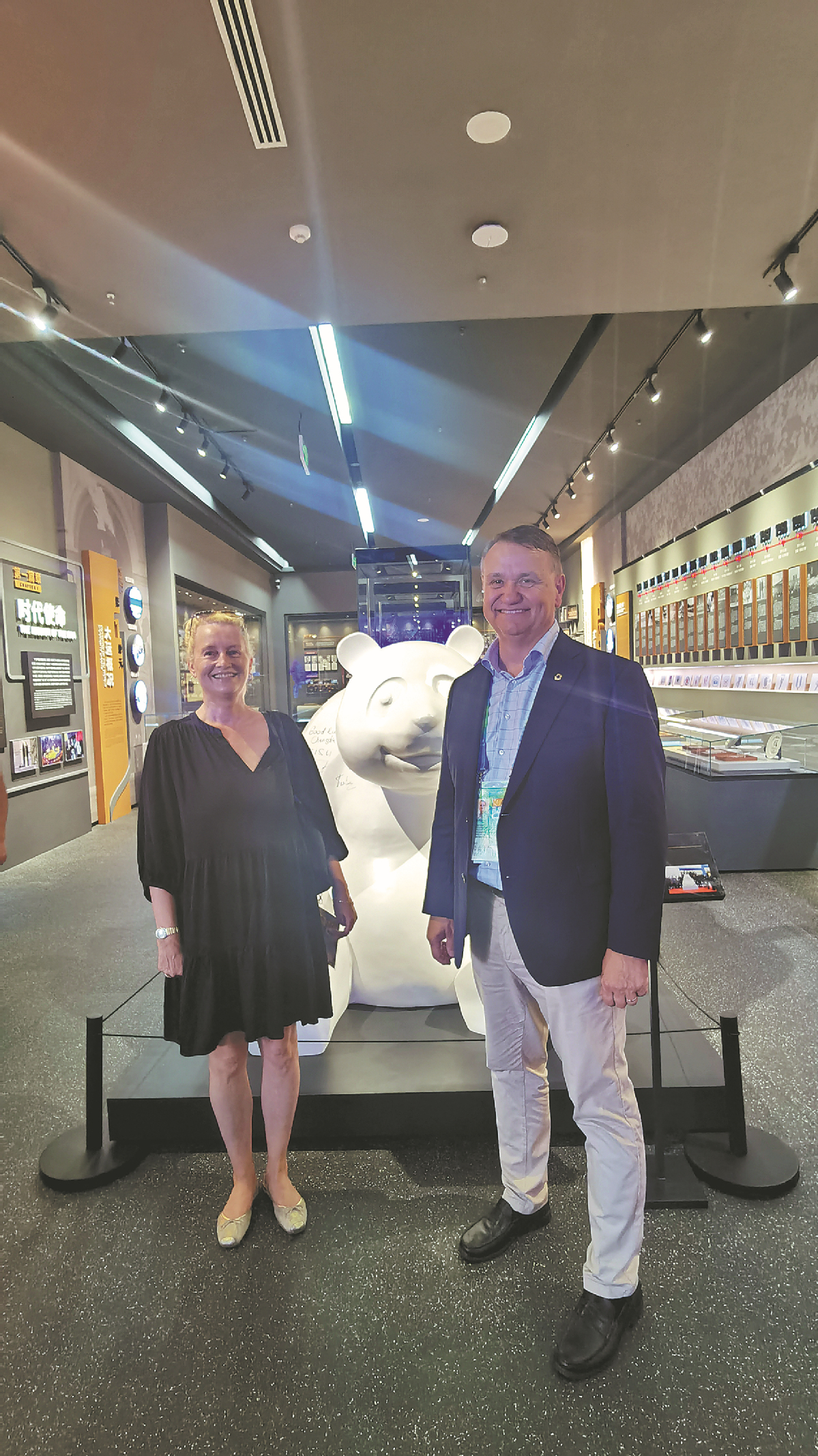
Stefan Berg and his wife. Provided to CHINA DAILY
During his recent visit to the Chengdu World University Games Museum at the Dong'an Lake Sports Park Multi-Purpose Gymnasium, Swedish official Stefan Berg was impressed by the display on the early history of the FISU.
Being a FISU emeritus honorary member, Berg was already very familiar with the international sports federation, but he admitted that he still learned a lot from the museum when he visited with his wife on July 29.
The exhibition hall covers an area of 3,300 square meters, with the museum boasting more than 1,000 physical items and nearly 80,000 digital exhibits.
In addition to objects from the Chengdu FISU World University Games, visitors to the exhibition can see medals, torches, mascots and graphic and audio-visual materials from previous editions of the University Games dating back more than half a century.
Soon after a visitor steps into the museum, a white giant panda sculpture comes into view.
Student-athletes at the games are invited to leave their signature on the panda to commemorate their visit to Chengdu.
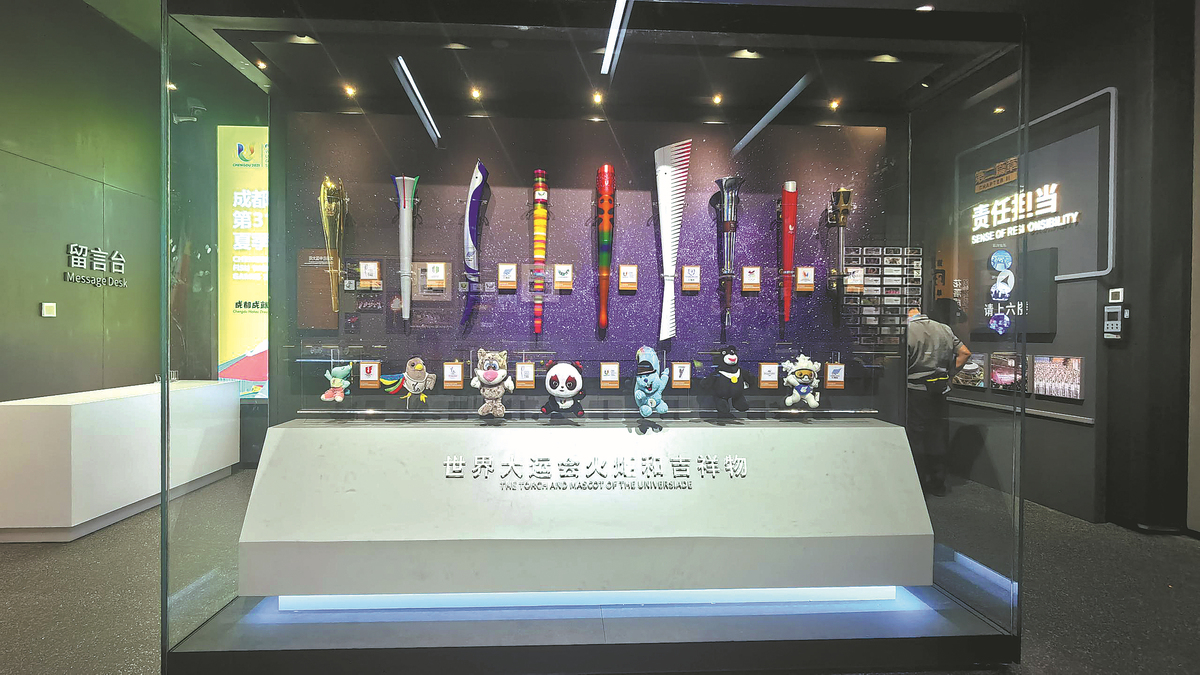
Torches and mascots from the past FISU University Games are on display at the Chengdu World University Games Museum. Provided to CHINA DAILY
Among the exhibits in the museum are the "three treasures" of the Chengdu games — Ronghuo, Rongguang and Rongbao, explained Zhang Ruiqin, a leading official with the executive committee of the Chengdu games.
Ronghuo, which literally means "Chengdu flame", is the torch of the games. Rong means "hibiscus" and can be pronounced as harmony in the local dialect. It is another name for Chengdu, whose city flower is the hibiscus.
Rongguang means "Chengdu glory" and is the medal of the games; Rongbao literally means "Chengdu treasure" and is the games' mascot — which is modeled on Zhima, a giant panda from the world-famous Chengdu research base for the rare species.
In the central area of the museum are torches, including Ronghuo, from recent editions of the FISU University Games. With the four colors of vermilion, bright yellow, emerald green and lake blue, Ronghuo represents the warm, energetic and cosmopolitan lifestyle of Chengdu as well as the vibrant youth of the student-athletes.
Before the opening of the Chengdu games, the FISU designated its acting president, Leonz Eder, as the museum's honorary curator, said Huang Yongzhi, an official in charge of the museum's planning and construction.
"If you go to the museum, you can see the development of sports via the different designs of the medals. If you compare medals from before and now, the technology nowadays has changed so much," Eder said.
"And I encourage everybody to go there, not only to learn about the history of the games, but also to get inspired by the past."
