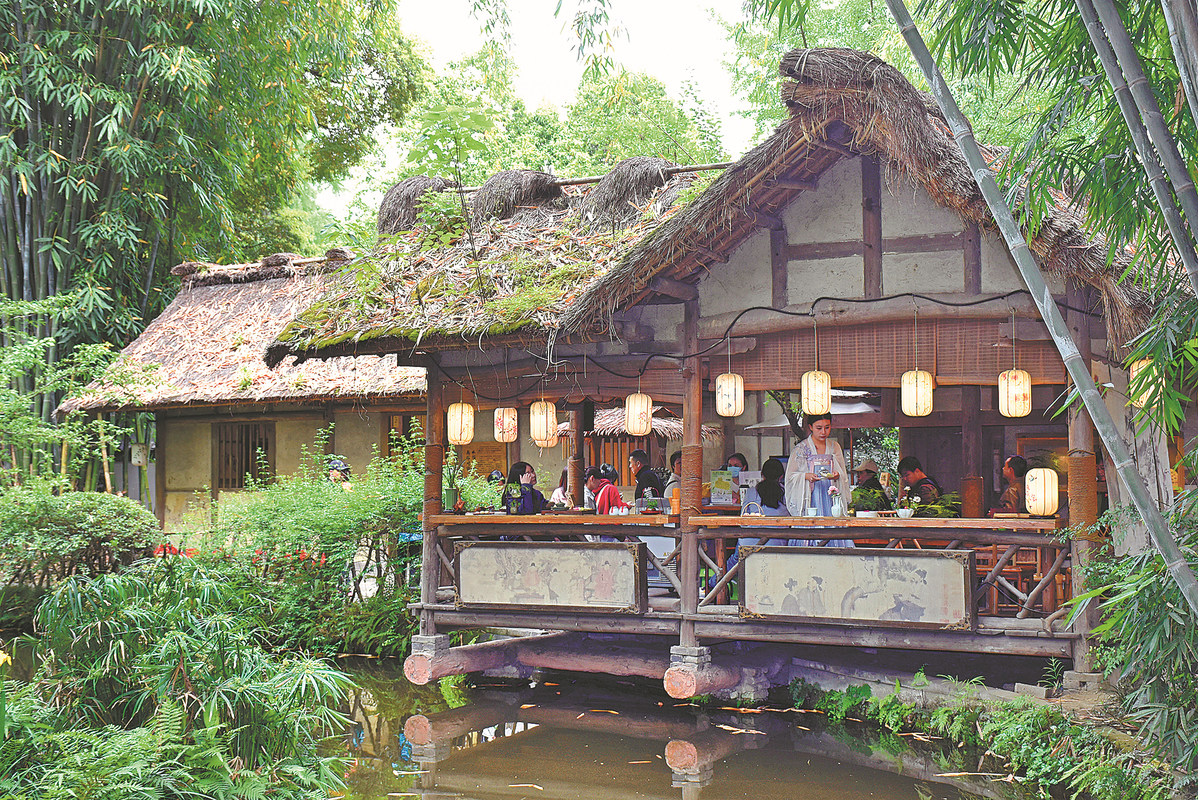
The Du Fu Thatched Cottage is one of the most popular cultural landmarks for visitors. CHINA DAILY
First-time visitors to Chengdu, Sichuan province, may find it to be a city with rich cultural heritage.
They may notice the emblem of a circular gold leaf, featuring four flying birds surrounding the sun, in many parts of the city — it is on the overpass of the People's Road South leading to Shuangliu International Airport, on souvenirs in visitors' destinations and on the TV screen when one tunes in to the Chengdu station.
The emblem, which represents Chengdu, was chosen as the symbol of China Cultural Heritage by the State Administration of Cultural Heritage in 2005.
A gold-leaf sunbird, believed to be about 3,000 years old, was excavated from the Jinsha Ruins in Chengdu in 2001. The ruins were hailed as one of Sichuan's most important archaeological finds after the discovery of the Sanxingdui Ruins in the city of Guanghan in 1929.
In 2018, Chengdu made the decision to build itself into a world cultural city.
In recent years, Chengdu's efforts to globalize have been ramped up, and a series of major international cultural and sports activities have been held, laying the foundation for it to build itself into a world-famous tourist city, said Guo Degang, an official with the Chengdu Municipal Bureau of Culture, Radio and Tourism.
Chengdu's cultural tourism includes giant pandas, Three Kingdoms (220-280) culture, poetry, leisure, food and fashion, he said.
In addition to sites such as the Jinsha Ruins, Chengdu is known for the Temple of Marquis Wu and the Du Fu Thatched Cottage, which are the representatives of its Three Kingdoms culture and poetry culture.
Hidden in thick greenery, the Temple of Marquis Wu in downtown Chengdu looks more like a garden than a centuries-old temple.
The temple was built as a memorial hall to commemorate Zhuge Liang (181-234), then prime minister of the Shu Kingdom (222-263) and now China's personification of loyalty and wisdom. He was awarded the title of Marquis Wu.
The temple, which also houses the tomb of Liu Bei, emperor of the Shu Kingdom, is one of the best-preserved remnants of the Three Kingdoms period — the Wei, Shu and Wu — some 1,800 years ago.
The three states were locked in constant war, trying to reunify the country while creating legends passed down from generation to generation.
Covering about 150,000 square meters and enclosed by red walls, the temple boasts relics from several dynasties, including 47 gilded or painted statues of important figures in the Shu Kingdom.
A thatched cottage built in line with the description of poems by Du Fu (712-770), one of China's greatest poets, opened to visitors in 1997.
A museum with the cottage, which offers a traditional Chinese-style garden, is a must for first-time visitors.
Du's fame has endured in China. His poems are included in textbooks and are prescribed readings for any foreign student majoring in Chinese literature.
Du, a native of Gongxian, Central China's Henan province, reached Chengdu in 759 to take refuge from an eight-year war waged by two rebel generals.
The following spring, he built a cottage by the Flower Bathing Brook. He lived a peaceful life for about four years in the cottage, writing 240 of his extant 1,455 poems.
