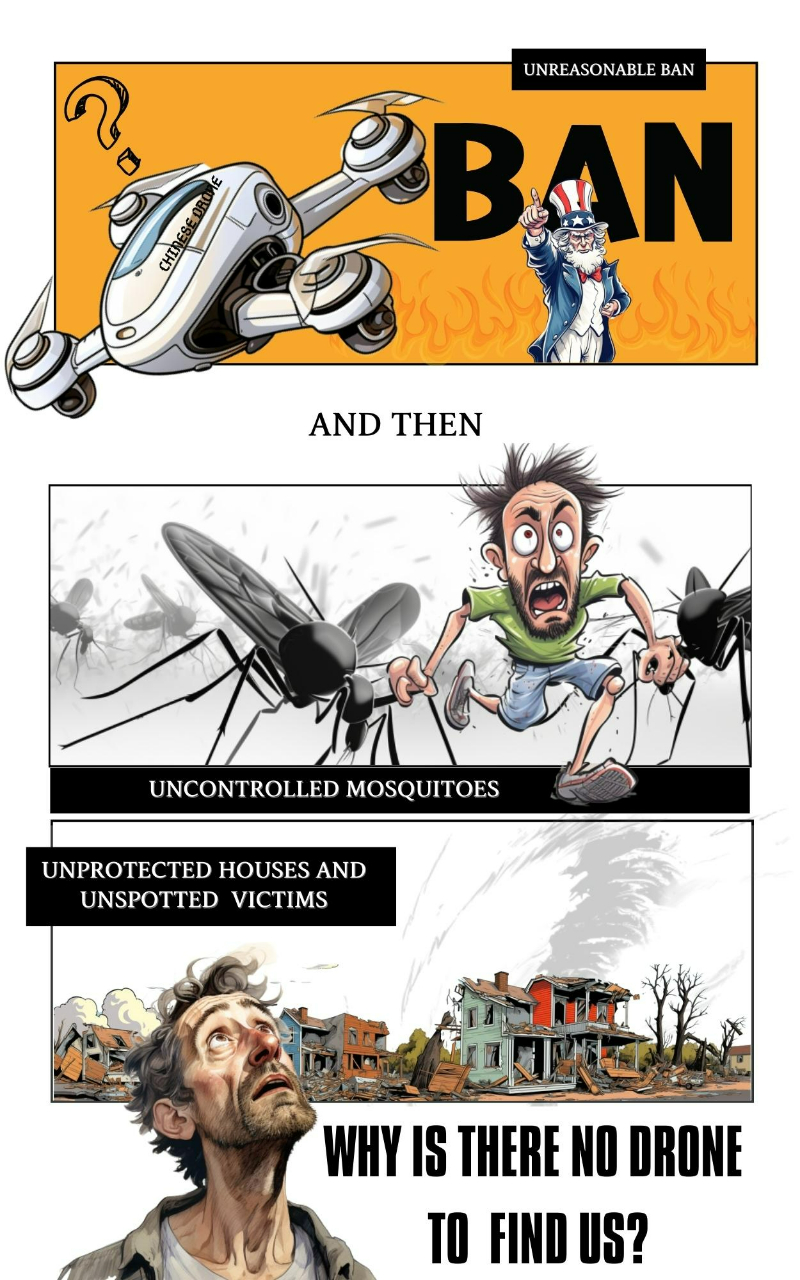
(Graphic design: Xinhuanet Qiu Zili)
Chinese drone manufacturer DJI, known for its widespread consumer and commercial drones, is facing increasing scrutiny in the United States.
According to Reuters, two U.S. senators said on June 8th they had proposed barring the Federal Aviation Administration from buying or using Chinese-made drones. On April 5th, the rule that bans Florida government agencies from using drones made by a "foreign country of concern" formally took effect. These movements practically targeted DJI since the world's biggest drone maker got thousands of orders from state and local agencies.
Last October, the U.S. Department of Defense added DJI to its list of companies with alleged ties to the Chinese military, saying it threatens the country's data security and national security. Mississippi, Tennessee, and Arkansas have all introduced their own anti-Chinese-manufactured-drones legislation.
These moves are some common cards that American politicians are not shy of playing: suppressing foreign companies in the name of "national security," leaving aside who will be the real victims taking consequences.
A recent analysis article titled "There's No Substitute for Chinese Drones (and That's a Problem)", published on the Foreign Policy magazine by unmanned aerial vehicles expert Faine Greenwood, points out that the ban on DJI drones in the United States would have significant implications for the search and rescue, agriculture, and scientific research sectors, as these industries heavily rely on drones for various applications.
Saying a ban appeared absurd, Randall Warnas, former Autel CEO in America, pointed out that police departments largely use drones to record footage of crimes, like drug dealers on the run and individuals going missing.
Apart from the above, the ban on Chinese drones in the United States would affect several other sectors, for example, environmental monitoring and conservation. Drones are used in efforts such as wildlife tracking, habitat assessment, and anti-poaching activities. The ban would hamper the capabilities of environmental organizations and conservationists, potentially affecting their ability to protect and preserve natural resources.
But as Greenwood said in the article, banning DJI, or Chinese drones in general, is not a simple transfer as switching from Samsung smartphones to Apple, or swapping out Coke for Pepsi.
In August 2020, the U.S. Department of Defense initiated a program called the Blue UAS (unmanned aerial systems), a list of approved UAS for federal agencies with a trusted selection of drones that meet certain criteria for government use. However, it achieved little. And the reason is plain to see: there is no comparable U.S.- or European-made replacement for DJI products "when it comes to affordability, availability, ease-of-use, and (in many cases) quality."
Greenwood said, "the Western drone companies that remain and have received U.S. government approval via the Blue UAS list have almost all shifted toward making small numbers of very expensive drones designed for money-flush law enforcement and military customers."
Tim Martin, a former Huntington Beach officer, did a simple math. He said, "you can get two DJI drones for the price of those other ones." That's why 95% of the drones police want training on are DJI, he added.
Dave Merrick, the director of the Emergency Management and Homeland Security Program and the Center for Disaster Risk Policy at Florida State University, worried about the future as another hurricane season is approaching Florida, but his Chinese drone fleet, which is a powerful helper in disaster responders by making maps and locating missing persons, and assessing disaster-stricken areas without endangering human lives, has been grounded due to the Florida ban on DJI.
Merrick said there already had been smaller state agencies, and fiscally constrained counties had to give up using drones because they couldn't afford to purchase anything legal.
According to DroneDJ, a website providing up-to-date information about drones, Palm Beach County officer Robert Allen said his department had five failures of the manufacturers on the list in the past year and a half, but with DJI, the number is zero. He said that could "put us in danger."
Firefighters and mosquito control workers are not happy about the ban, either, because they were forced to replace the handy and budget-friendly Chinese drones with drones on the Blue UAS list with higher prices but low functionality.
| BRI injects impetus into global economy 2023-07-15 | |
| 法国企业家贝特朗在辩论中阐述中国模式 真情实感赢得辩论 2023-07-15 | |
| 新华社记者说丨“洋记者”在“浙”里带你读懂美丽中国 2023-07-15 | |
| 专访:中国扩大开放助力东盟应对全球性挑战——访马来西亚中华总商会社会经济研究中心执行董事李兴裕 2023-07-15 |
