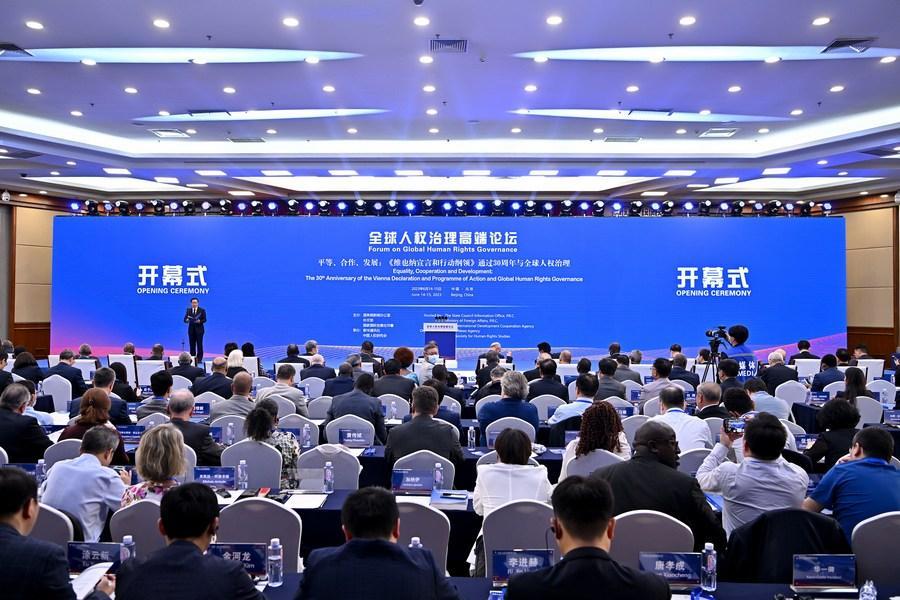
This photo taken on June 14, 2023 shows the opening ceremony of the Forum on Global Human Rights Governance in Beijing, capital of China. The Forum on Global Human Rights Governance opened in Beijing on Wednesday. [Photo/Xinhua]
Participants from various countries and international organizations attending the Forum on Global Human Rights Governance from June 14-15 expressed their strong support for China's proposals, which they believe play a crucial role in fostering global human rights development and governance and addressing contemporary challenges.
William Jones, a former White House correspondent for Executive Intelligence Review, underscored China's increasing global influence, saying that "China's role in protecting the human rights of its citizenry is deserving of much praise." He also noted the unprecedented situation the world finds itself in, and the importance of China's philosophy and initiatives in the global arena, including the Global Security Initiative (GSI).
Liu Xinsheng, a human rights expert with the U.N. Human Rights Council Advisory Committee, concurred with this view, highlighting the positive impact of China's wisdom and solutions to global human rights governance through the resolution "Promoting Mutually Beneficial Cooperation in the Field of Human Rights" adopted by the U.N. Human Rights Council.
He emphasized that the resolution aligns with the current trend of global development and helps enhance the discursive power of developing countries in the international human rights field.
Addressing the inadequacies of the current paradigm of global human rights governance, Chang Jian, director of the Human Rights Research Center at Nankai University, lauded China's concept of building a community with a shared future for mankind for offering a new pattern of "solidarity and cooperation" that can overcome the limitations of the existing governance model.
He criticized the practice of some Western countries dominating the current global governance of human rights. "The voice of developing countries has not been proportionally expressed," he said, adding that China actively advocates increasing the representation and voice of developing countries in the global human rights governance system, and promotes international cooperation in human rights to fully respect and reflect the will of developing countries, so as to ensure all countries have a share in shaping the future of the world.
Liu Qing, vice president of the China Institute of International Studies, also emphasized the importance of respecting each country's chosen path for human rights development based on its national conditions. He stressed the need to promote and protect all types of human rights and advance international human rights dialogue and cooperation. He pointed out that the values contained in the GSI transcend different systems and ideological barriers, and contribute to the maintenance of common human civilization values.
Ong Tee Keat, chairman of Malaysia-based think tank the Center for New Inclusive Asia, extolled China's GSI for filling the void of a viable global security architecture that addresses both conventional and non-conventional security concerns. He stated, "GSI's call for a 'common, comprehensive, cooperative and sustainable' security rooted in the principle of 'indivisible security' where no country can strengthen its own security at the expense of others is a breath of fresh air in the contemporary global security governance dominated by unilateral sanctions, long arm jurisdiction and antagonistic military pacts."
Crispin Kaheru, commissioner of the Uganda Human Rights Commission, highlighted China's role in leading the way and peacefully turning the tide in human rights development. Speaking of the optimism this has given many countries, he said, "If China can do it, then every other country can do it." He also hailed the GSI as an action-oriented architecture that has exposed the inadequacies of the current international human rights system and demonstrated that global peace is possible through peaceful means.
Zhang Yunfei, a board member of the U.N. Association of China, emphasized that the Global Development Initiative aims to speed up the implementation of the U.N. 2030 Agenda for Sustainable Development, advocating for true multilateralism and promoting common development. He said that this initiative injects new momentum into global human rights governance and represents China's new contribution to promoting international human rights. He also noted that the initiative contains rich human rights philosophy and is an important public good provided by China for global governance.
