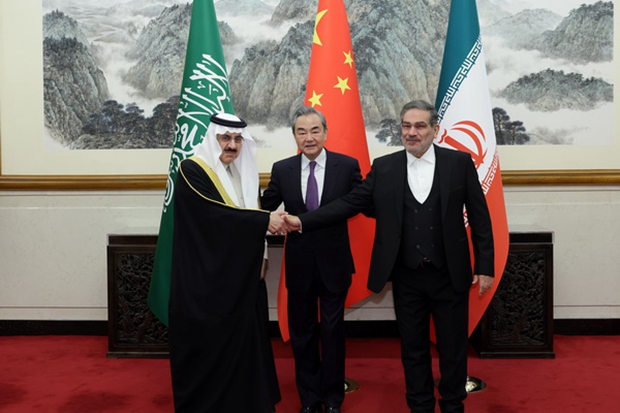
Wang Yi (center), a member of the Political Bureau of the Communist Party of China Central Committee and director of the Office of the Central Foreign Affairs Commission, with representatives from Saudi Arabia and Iran in Beijing on March 10, 2023. [Photo courtesy of fmprc.gov.cn]
Politics are often obscure and difficult to understand. Politics in the Middle East, in particular, tend to be even more complex due to religious and sectarian cleavages. Within such an environment, stability is often desirable but hard to achieve. The recent agreement between Saudi Arabia and Iran brokered by China breaks the stalemate and creates cautious optimism for better days in the Persian Gulf.
Iran and Saudi Arabia agreed to resume diplomatic relations and re-open their embassies after seven years. The two countries cut ties in 2016 following years of tensions, which included the Mecca stampede in 2015, the execution of prominent Shiite cleric Nimr al-Nimr by Saudi Arabia, and the subsequent storming of the Saudi Embassy in Tehran. Under China's umbrella, and with the assistance of Iraq and Oman, which hosted several rounds of preparatory discussions, Tehran and Riyadh decided to make a breakthrough toward reconciliation.
The trilateral statement signed in Beijing makes reference to two separate agreements Iran and Saudi Arabia had made in 1998 and 2001. The first covered the fields of economy, trade, investment, technology, science, culture, sports, and youth development. The second referred to security cooperation. Both countries appear now committed to re-energizing and implementing those agreements. This means that there is a solid basis for negotiations according to the common ground reached more than 20 years ago. Within this context, the trilateral statement also refers to "brotherly ties" between Tehran and Riyadh.
No doubt, China's mediation has been critical in achieving this positive outcome. China does not celebrate, though. Challenges ahead are tough, and the trilateral Beijing statement ought to yield results in the medium and long term. Among other things, the Yemen civil war, where Iran and Saudi Arabia are actively embroiled and support opposing sides, continues. According to the U.N., more than 21 million Yemenis – two-thirds of the population – still require assistance and protection. Additionally, the international community has not yet managed to find a solution to Iran's nuclear program following the withdrawal of the U.S. from the 2015 Joint Comprehensive Plan of Action (JCPOA) under the administration of Donald Trump five years ago.
The U.N. Secretary-General António Guterres welcomed the Beijing tripartite statement, expressed appreciation to China, and said that "good neighborly relations between Iran and Saudi Arabia are essential for the stability of the Gulf region." Permanent members of the Security Council, France, Russia, and the U.S., also saluted the re-establishment of diplomatic relations between Iran and Saudi Arabia. This is the case with the EU, which asserted that the de-escalation of tensions is placed in its interest.
More importantly, regional actors are satisfied. Bahrain, Jordan, Kuwait, Pakistan, Syria, Turkey, and the UAE are among the countries that issued statements almost immediately. The more an agreement is endorsed within a specific region, the more likely it is to flourish. Positive peace will only be fostered if accepted by main stakeholders. Secretary-General of the Organization of Islamic Cooperation (OIC) Hissein Brahim Taha expressed the hope that the Iranian-Saudi step would give new momentum to collaboration among OIC member states.
Mediating between Iran and Saudi Arabia, the Chinese government is certainly giving peace a chance. As already mentioned, this is not the end of the diplomatic route but a crucial beginning. The more China grows, the more its international responsibilities increase. It is thus important to carefully study Chinese foreign policy.
